
How Participatory Art Drives Community-Level Change, from Peru to Tanzania
Updated: Aug 3
By: Isabel Carrió
At Creative Action Institute, we've seen how art makes social change possible. When people create together, they build the trust to talk honestly, break down barriers, and design their own solutions to complex problems requiring coordinated community action and shifts in behavior.
This case study follows two projects that show how this process works in practice: one with Maijuna Indigenous women protecting their territory in Peru, and one with adolescent girls advancing girls' education in Tanzania. Both projects were led by local staff trained in Creative Action Institute's creative leadership curriculum, and together they show how participatory art can spark real change in communities, even across regions as different as these.
Project 1 — Latin America
Project: Conservation, Worldview, and Gender in Maijuna Communities (Peru)
Organization: One Planet
Program: CELP
In the Maijuna-Kichwa Regional Conservation Area, threatened by deforestation and illegal resource extraction, a CAI trained local leader facilitated a week-long arts-based workshop to empower Maijuna women to recognize themselves as leaders and stakeholders in the fight for the protection of their territory.
The workshops began with a simple question: what do we protect, and why? At first, the women were quiet. But over three days of collaborative drawing, painting, and storytelling, they began to connect with each other and with stories of powerful women who came before them.

The workshop culminated in the creation of a mural. Together, the women painted a strong Maijuna woman standing beside a tigrillo, surrounded by palmeras de pijuayo, fruits, and woven chambira fiber. Every element was drawn from their own stories and their own understanding of what it means to belong to this place. The mural now stands on a public structure, and visitors come from across the Maijuna-Kichwa region to see it.

Working on the mural together gave the women time to connect and share knowledge, and to start seeing each other as leaders. That's what carried into what came next. One participant started teaching the Máíhèkè language at the local school. More women joined leadership spaces. New conversations opened up around identity, gender, food security, and conservation. It was also the first initiative to put Maijuna women at the center of a conservation and leadership process.
"As we shared our stories and painted together, we remembered what it means to be Maijuna. The mural reflects who we are, but the most important thing was everything we lived and learned during those days." — Melba, Maijuna leader
Project 2 – Africa
Project: Theater, Leadership, and Collective Action for Girls’ Education (Tanzania)
Organization: Girls Livelihood and Mentorship
Program: Sauti ya Dada
At Enoti Secondary School in Arusha, a group of adolescent girls identified that the poor academic performance of many of their peers was not an individual problem, but the result of social and cultural factors: teenage pregnancy, gender-based violence, domestic overload, and lack of family support.
Through theater, painting, and collective storytelling, the girls transformed their lived experiences into a shared narrative that not only revealed the root causes of poor academic performance among girls but also imagined practical solutions that their community could support.

Seated in a circle, they collectively created the story of Sarah, a 15-year-old girl who experiences abuse and faces barriers to continuing her education. Rather than ending with her struggle, the participants chose to imagine a different outcome: Sarah is listened to by her sister, supported by her parents and community, protected through legal action against her abuser, and ultimately able to continue her education and become a mentor to other girls. In doing so, the girls transformed their own concerns into a powerful vision of the change they wanted to see. One in which families listen to girls, communities protect them, and education becomes a shared responsibility.
The process culminated in an open presentation before students, teachers, families, and community leaders. After the performance, mothers, fathers, and teachers began a dialogue and made concrete commitments to reduce the domestic burden that limits girls’ study time, to become more involved in their education, and to expand mentorship spaces.
One of the most significant outcomes was the role the adolescents themselves took on: they shifted from being recipients of prevention messages to becoming creators of narratives capable of influencing their community.
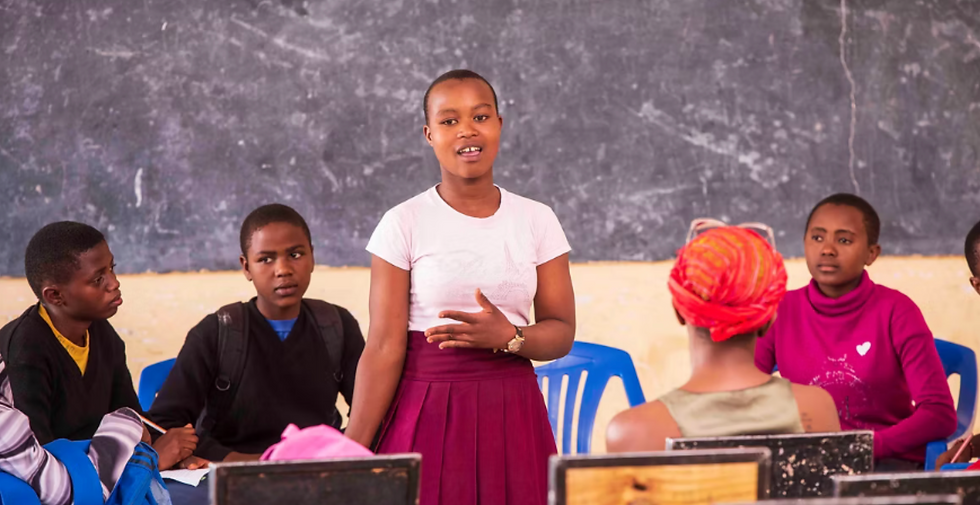
"With our theater skit on gender-based violence, I hope the community understands its causes, its consequences, and how we can address it by listening to and valuing the voice of girls."
— Elsie, Sauti ya Dada participant
What These Projects Teach Us
When communities have spaces to reflect, share knowledge, and build solutions rooted in their own realities, they strengthen their capacity to face complex challenges in more inclusive and sustainable ways.
Collaborative art projects create spaces that other approaches cannot
Creative processes built trust, opened dialogues, and made it possible to address sensitive topics such as: forest loss, gender norms, and violence through collective reflection rather than confrontation.
Leadership develops when people find their voice.
In both cases, participants did not only learn: they recognized themselves as agents of change. Art was the path that led them there.
The most relevant solutions come from communities themselves.
When people analyze their challenges through their own knowledge and creativity, the responses they build are more relevant, more lasting, and more truly their own.
Change continues long after the artistic process ends
Leaders trained through Creative Action Institute’s programs continue applying these methodologies in their organizations and communities, multiplying the impact far beyond the duration of any single intervention.
Over more than two decades, Creative Action Institute has developed and refined a methodology that combines creative leadership with participatory art. Its central strength lies in its adaptability: the same curriculum and the same principles can be applied to protect an indigenous territory in the Amazon or to advance girls’ right to education in Tanzania.
The two experiences presented here represent only a small part of Creative Action Institute's work.
Across Latin America, East Africa, and West Africa, partner organizations continue applying these methodologies through Creative Advocacy Practicums (CAPs) and programs including the Creative Environmental Leadership Program (CELP), Community Resilience Program (ComRes), Sauti ya Dada (The Girl's Voice), and East African Girls' Leadership Summit (EAGLS).


Comments